Pump
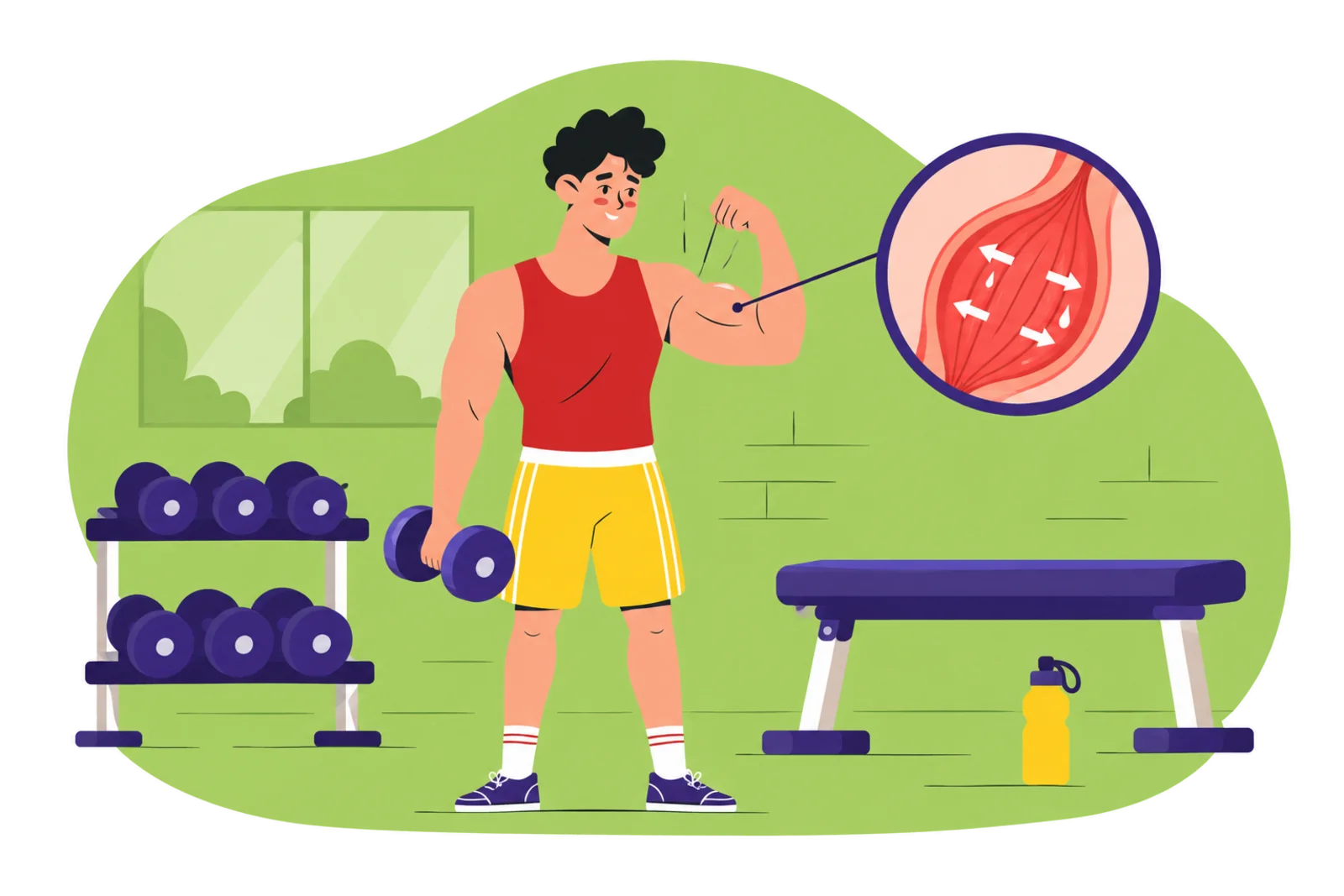
A muscle pump is the temporary feeling and appearance of fullness in a worked muscle during or shortly after exercise. It reflects acute swelling caused by changes in local blood flow and fluid distribution; it is not newly built muscle tissue.
Repeated contractions alter pressure in and around the muscle and move fluid among blood vessels, the interstitial space, and muscle cells. Higher-repetition sets, short rests, continuous tension, and intensity techniques often make the effect more noticeable. Exercise choice, hydration, temperature, carbohydrate and glycogen status, and individual anatomy can also change how strong the pump looks or feels.
The pump may give useful immediate feedback that a region is working, but it does not prove that the intended muscle received the best possible mechanical stimulus. A muscle can swell while technique shifts work elsewhere, and productive training can occur without a dramatic pump. Likewise, an acute increase in measured muscle thickness can reflect fluid rather than hypertrophy.
The possibility that cell swelling contributes to anabolic signaling has been discussed, but a causal role in long-term growth has not been established. A 2025 review of load-induced hypertrophy concluded that evidence does not support the pump as a meaningful cause of muscle growth. One small study in untrained young men found a moderate association between first-session swelling and later quadriceps growth, but an association in one exercise and population does not make pump a validated predictor or show causation.
Enjoying a pump is a reasonable preference, and pump-oriented work can still contain productive sets. Treat the sensation as optional feedback rather than a progression metric. Load, repetitions, range of motion, technique, effort, and changes in performance or body measurements over time provide more interpretable evidence. Sudden painful swelling, marked weakness, or swelling that does not settle is not an ordinary workout pump and should be assessed appropriately.