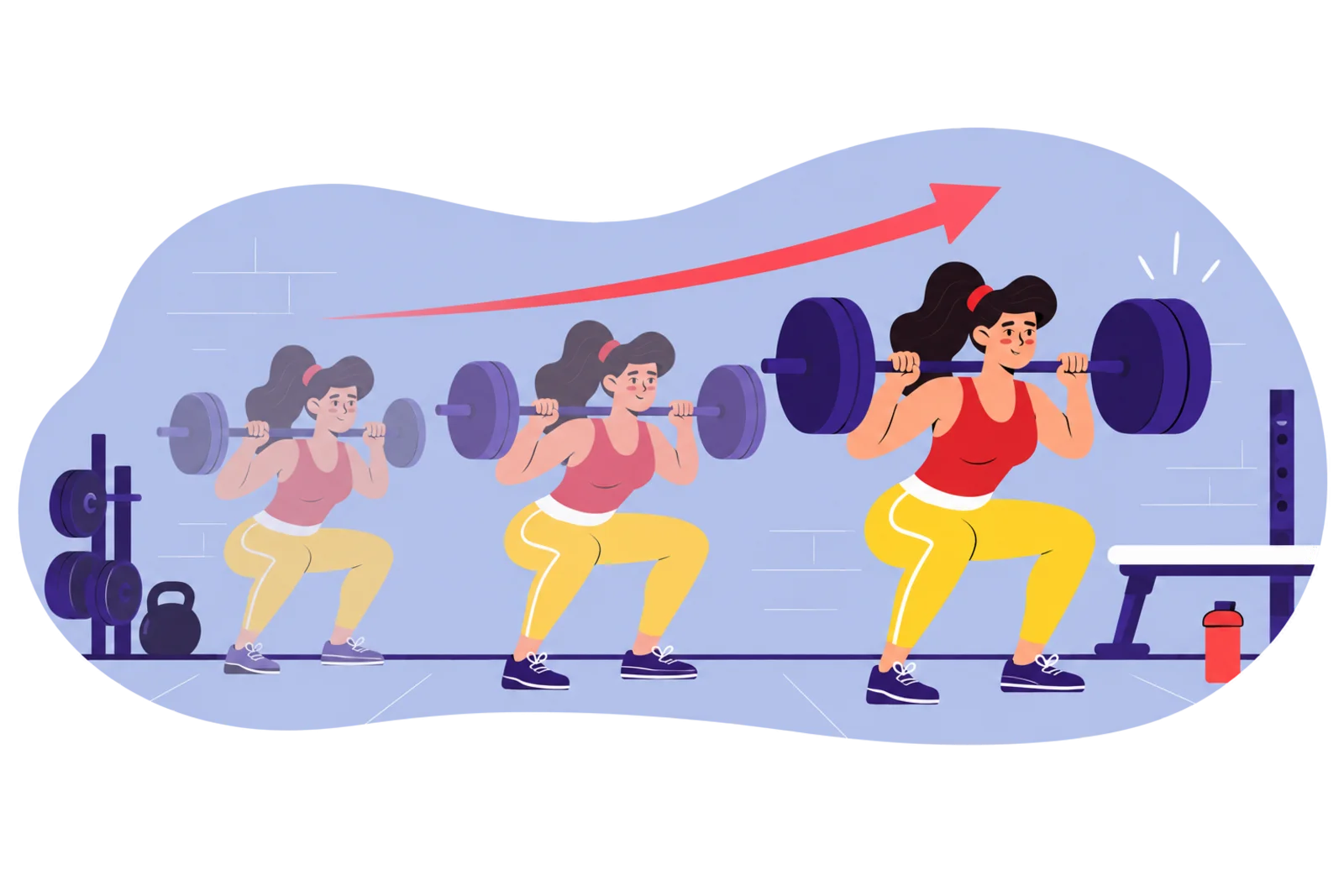
Progression
Progression in strength training is a purposeful improvement in performance or training capacity over time. It may appear as more weight or repetitions, but also as more high-quality sets, a larger controlled range of motion, better execution at the same load, or the same work with less effort. The relevant form of progress depends on the training goal.
Progression and progressive overload are closely related, but they are not identical. Progression describes the change in training or performance. Progressive overload is the broader principle of adjusting the challenge as your capacity improves so that training remains sufficiently demanding. Adding weight is therefore one progression option, not the definition of progress itself.
To judge progression, compare like with like. Record the exercise and setup, load, completed repetitions, working sets, range of motion, and, if useful, reps in reserve. A heavier squat is not clear progress if its depth changed substantially, and an extra pull-up may reflect a lower body weight rather than greater absolute pulling strength. Longer-term trends are more informative than an isolated personal record.
Progression does not have to occur in every workout. Sleep, stress, accumulated fatigue, exercise order, and ordinary performance variation can temporarily mask an adaptation. Beginners often progress quickly because many qualities improve at once, whereas experienced lifters usually need smaller changes and more time. A sustained lack of improvement across comparable sessions may indicate a plateau, but one difficult day does not.
A useful progression plan states what will change, when it will change, and what happens if the target is missed. Double progression raises repetitions within a range before load; linear progression usually increases a variable in regular steps. Neither method must continue indefinitely. A 2026 American College of Sports Medicine position stand found that resistance training reliably improves several outcomes in healthy adults, while the prescription variables that best support strength, hypertrophy, and power are not always the same. Progression should therefore serve the intended adaptation rather than merely make each workout harder.