Valsalva maneuver
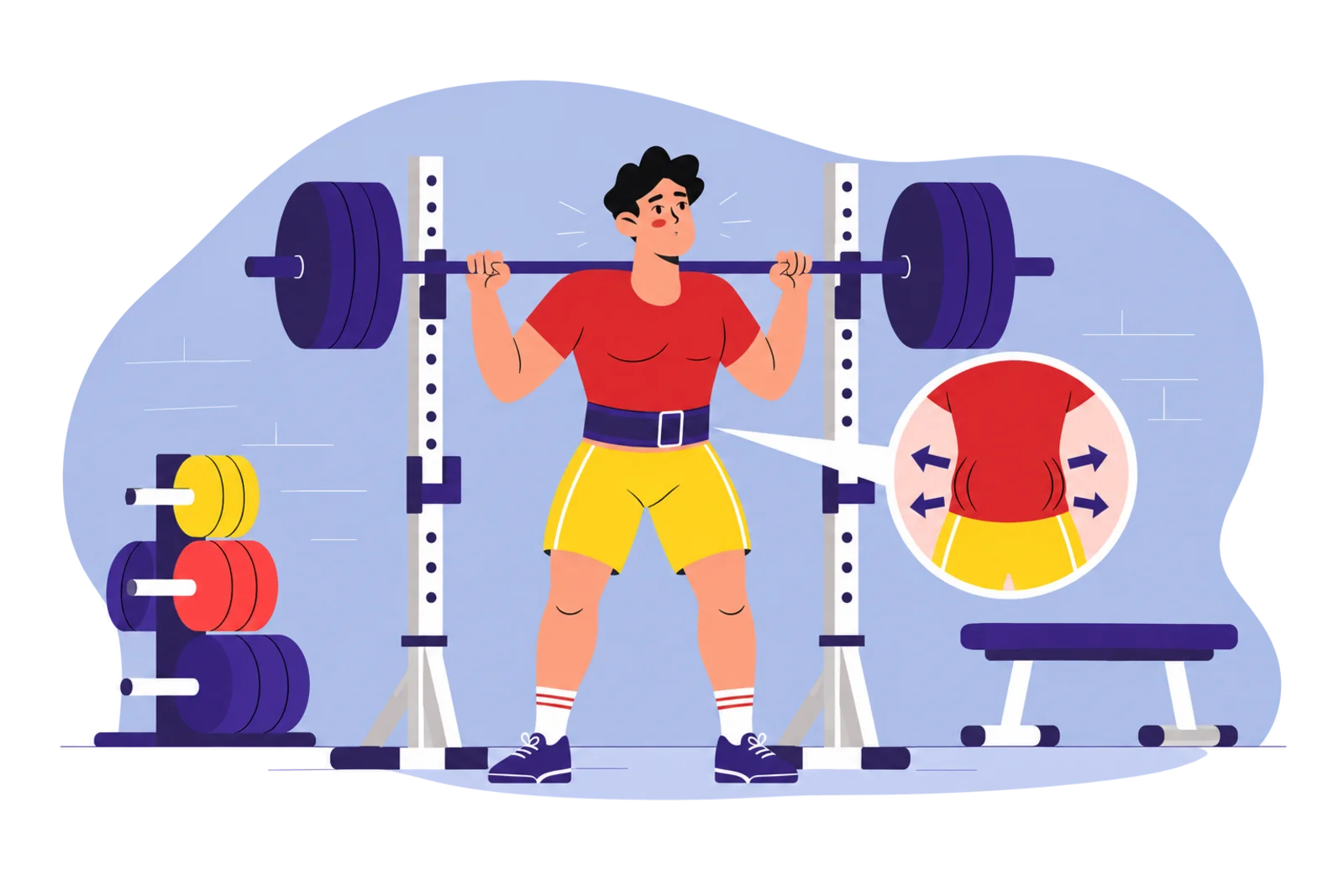
The Valsalva maneuver is a forceful attempt to exhale against a closed airway. In strength training, a lifter may briefly hold the breath while contracting the trunk muscles to create pressure and stiffness during a demanding repetition. It often accompanies abdominal bracing, but breath-holding and muscular bracing are not the same action.
A typical lifting application is to inhale before the repetition, close the glottis, brace the trunk, maintain pressure through the most demanding portion, and then release or reset the breath under control. The duration and timing depend on the exercise. Holding one breath across several slow repetitions is different from taking a new brace for each heavy repetition and may produce unnecessary lightheadedness.
The maneuver raises intrathoracic and intra-abdominal pressure. This can help the trunk resist movement under load, but it does not lock the spine in place or guarantee safe form. A systematic review of pressures during high-load resistance exercise found that pressure responses vary with exercise, load, breathing, and equipment. A lifting belt can change pressure and cueing, but it does not create the maneuver automatically.
Valsalva also produces substantial, rapid changes in blood pressure and blood flow. Those responses are one reason the technique is usually reserved for brief, demanding efforts rather than every repetition of light or endurance-oriented training. Exhaling through the effort or using a short, controlled breath hold may be more appropriate when maximal trunk stiffness is not needed.
The maneuver is not suitable to prescribe universally. Someone with a known cardiovascular, cerebrovascular, or eye condition, or anyone advised to avoid straining or breath-holding, should obtain individualized guidance from the clinician who knows their condition. Chest pain, fainting, a sudden severe headache, visual disturbance, or unusual breathlessness during lifting are not normal technique cues; stop the effort and seek appropriate medical assessment.
Learning under a qualified coach can help coordinate breathing with compound exercises without extending the hold longer than necessary. The goal is a repeatable brace for the task, not maximal pressure for its own sake.