Metabolism
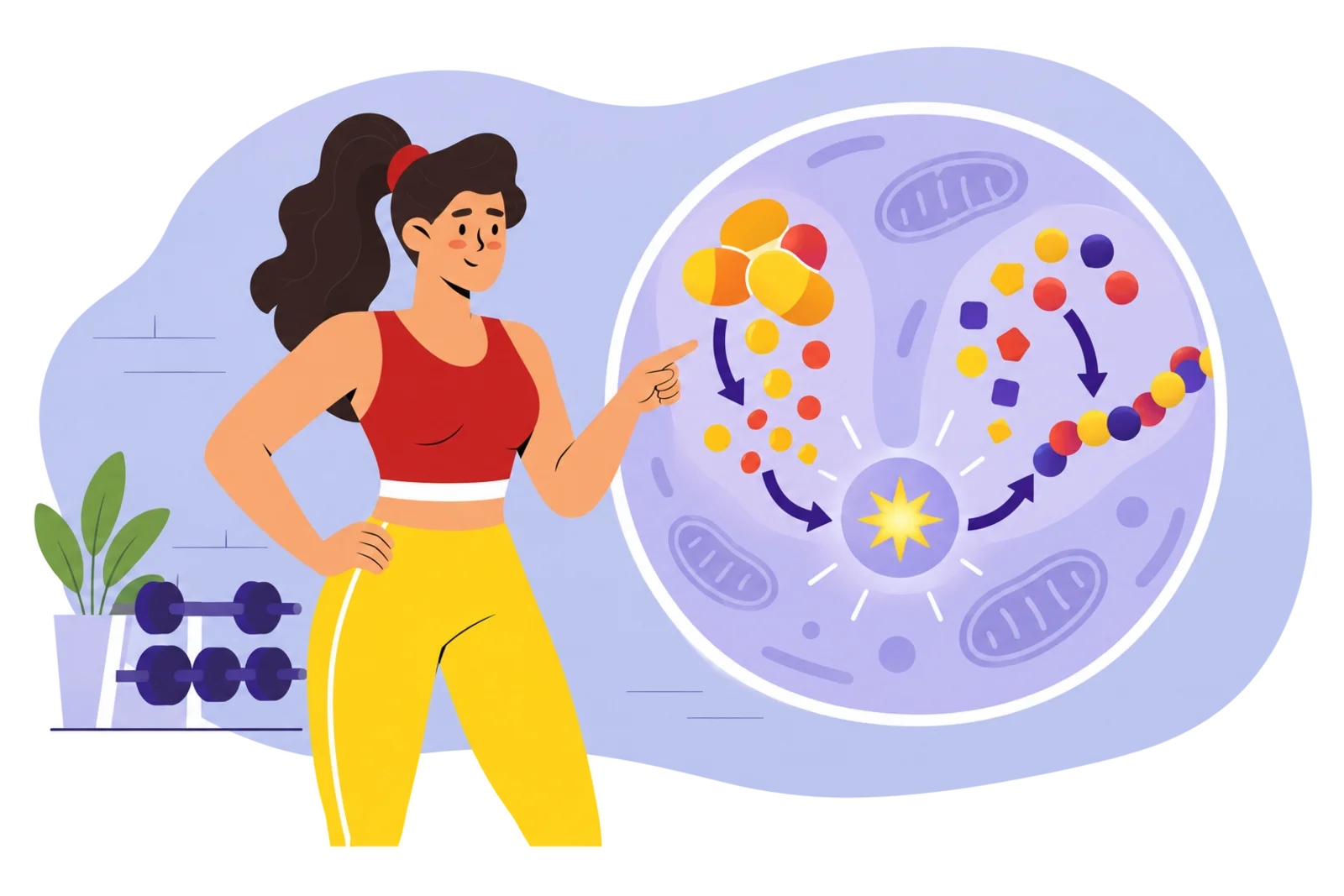
Metabolism is the complete set of chemical reactions that keeps cells and the body functioning. It includes catabolism, which breaks molecules down and makes energy or building blocks available, and anabolism, which uses energy to build and maintain molecules and tissues. Both occur continuously rather than switching on only during a workout or meal.
Metabolism is not synonymous with how many calories someone burns. Metabolic rate describes energy use over time. The basal metabolic rate covers energy required under strict resting conditions, while total daily energy expenditure also includes physical activity and the thermic effect of food. Digestion, temperature regulation, tissue turnover, movement, and countless cellular processes all form part of the wider system.
Body size and composition, age, sex-related physiology, genetics, organ activity, food intake, movement, environment, hormones, medication, and illness can influence energy expenditure. More muscle can raise resting needs because tissue requires energy to maintain, but the increase from a realistic amount of muscle is not a dramatic "metabolism reset." Strength training also uses energy and supports function independently of any afterburn effect.
During weight loss, expenditure often declines because a smaller body costs less energy to maintain and move, spontaneous activity can change, and adaptive responses can occur. This is not a permanently "broken" metabolism and does not stop energy balance from applying. The NIDDK Body Weight Planner’s dynamic model illustrates that calorie needs and the rate of weight change adjust over time rather than following a fixed calories-to-weight equation.
Metabolism is also not controlled by one food, supplement, or hormone. Insulin, thyroid hormones, stress hormones, and many other signals regulate particular pathways, while total body-weight change emerges from interacting intake and expenditure over time. A short-lived rise in energy use after a meal or workout does not by itself produce meaningful fat loss.
In muscle-building discussions, muscle protein synthesis is one metabolic process among many. An acute increase is not direct proof of long-term muscle gain. Training stimulus, nutrition, recovery, and repeated net tissue changes across weeks and months determine the practical outcome.