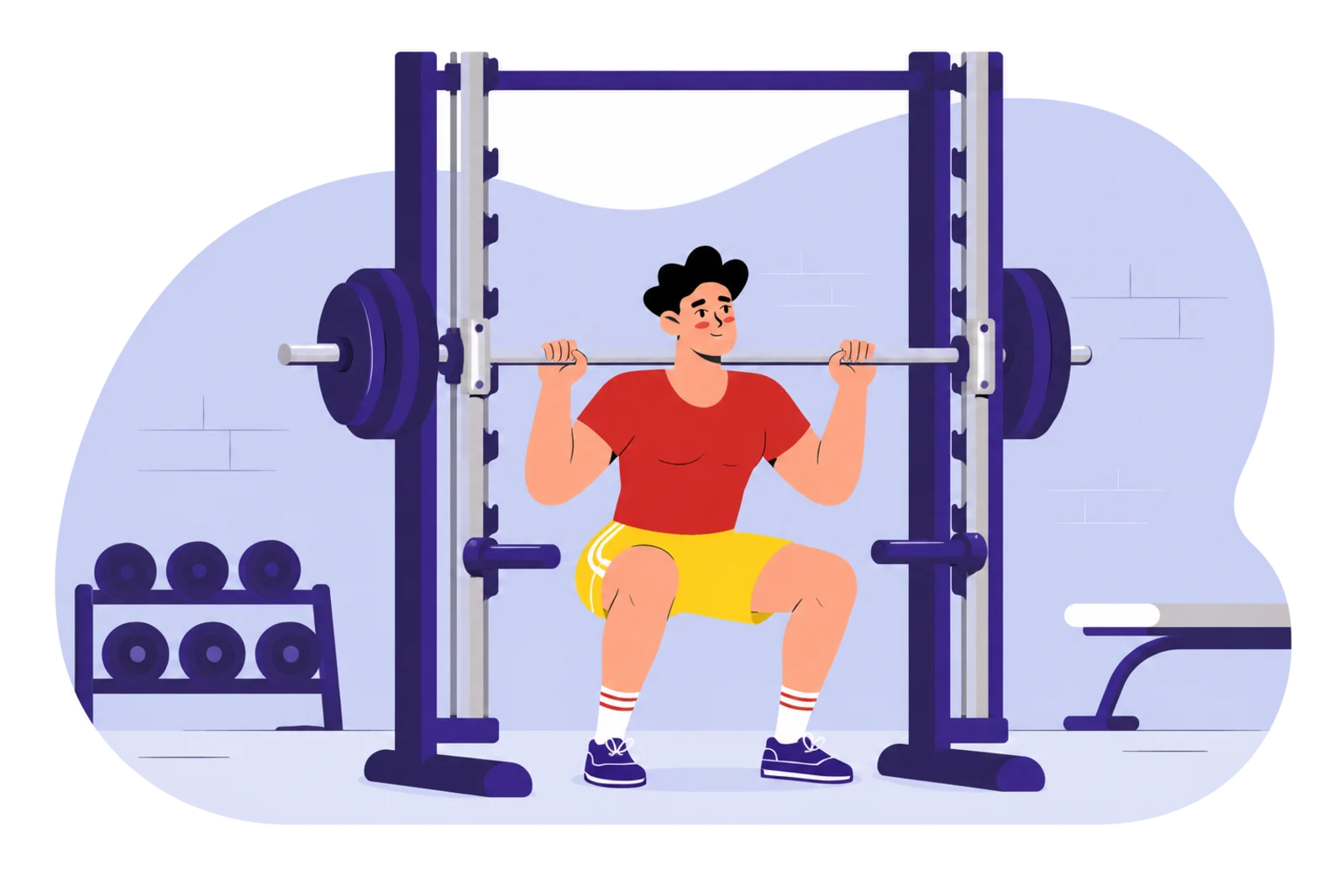
Smith machine
A Smith machine is a resistance machine with a bar that travels on fixed rails. The bar usually has rotating hooks that can be racked at several heights, and the frame may include adjustable safety stops. Although plates are loaded onto a bar, the guided implement is not a free barbell.
Rails may be vertical or angled, and models differ in effective bar weight, counterbalancing, friction, and hook design. The plates on the sleeves therefore do not always represent the complete resistance, and the same plate load can feel different on another Smith machine. For progress tracking, use the same machine when possible and record a consistent loading convention rather than comparing the number directly with a free-weight lift.
The rails remove some degrees of freedom and reduce the stability required to control the bar in space. This can help standardize an exercise or let a lifter focus on producing force, but the fixed path also constrains how the bar can move relative to the body. A stance that works on one rail angle may feel awkward on another. Position yourself so the intended joints can move through a controlled, tolerable path; do not force a free-weight setup onto every model.
Smith machines are used for squats, split squats, presses, rows, calf raises, and other movements. The useful variation depends on the training goal, individual fit, and form. More plates can be used in some Smith-machine exercises because balance demands or effective bar weight differ, but that does not make the result directly comparable with the free-weight version.
Hooks and stops are safety features, not automatic protection. Set the stops just below the intended bottom position when appropriate, test the path with an unloaded or light bar, and learn how to rack it before a hard set. A failed repetition can still trap the user if the stops are absent, misplaced, or bypassed.