Muscular power
Also known as: Explosive strength
Muscular power is the ability to produce force at high speed. In mechanical terms, power is the rate of doing work and can be expressed as force multiplied by velocity. "Explosive strength" is often used for the closely related ability to raise force rapidly, but rate of force development and power are not identical measurements.
Power differs from maximal strength, where the highest force or load matters even if the movement is slow, and from strength endurance, where force must be sustained or repeated. It is also not what powerlifting directly scores: that sport rewards the heaviest accepted squat, bench press, and deadlift, not force multiplied by bar velocity.
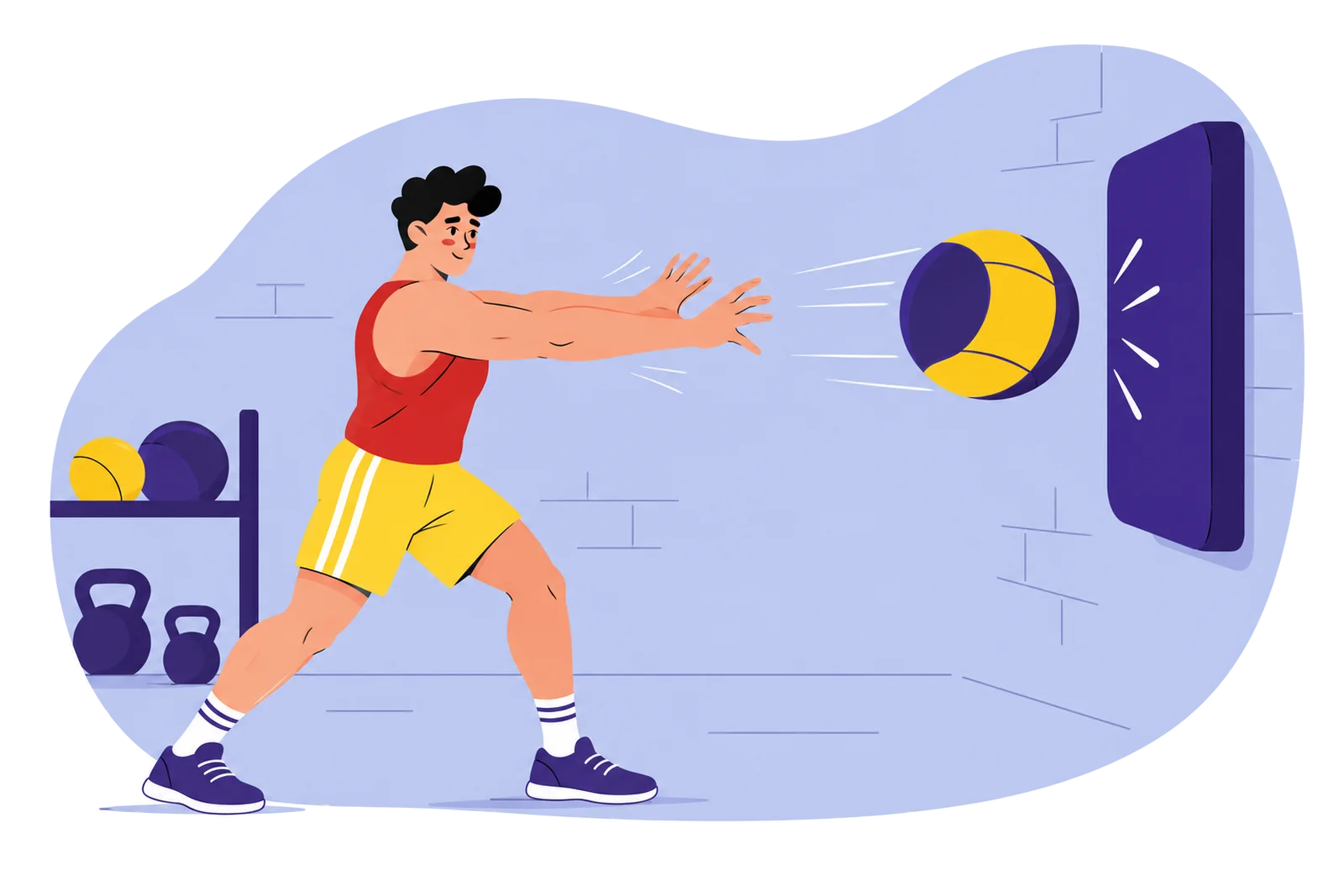
Jumps, throws, sprints, Olympic-style lifts, and ballistic resistance exercises are common power tasks. Training typically uses an explosive movement intention, a load that still permits useful velocity, and sets that end before substantial speed or technique loss. In its overview of resistance-training evidence, the 2026 ACSM position stand found greater power gains on average with moderate loads, low-to-moderate volume, Olympic-style weightlifting, and a fast concentric phase. The suitable load still depends on the exercise and athlete; a medicine-ball throw and a loaded squat jump do not share one universal percentage.
Building maximal force capacity can raise the ceiling for power, but heavy, slow lifting alone may not fully develop the ability to express that force quickly. The specificity principle favors practice with the movement patterns, velocities, and time constraints relevant to the goal. A controlled eccentric phase may prepare the position, while the intended concentric rep tempo is fast even when a heavy load moves slowly.
Peak or mean power can be measured with force plates, linear transducers, cycle ergometers, or other validated devices. Without such equipment, jump height, throw distance, sprint time, and movement velocity can serve as task-specific performance indicators. Comparisons require the same technique, load, device, and testing protocol; otherwise a higher reported wattage may reflect a changed test rather than improved power.