Mechanical tension
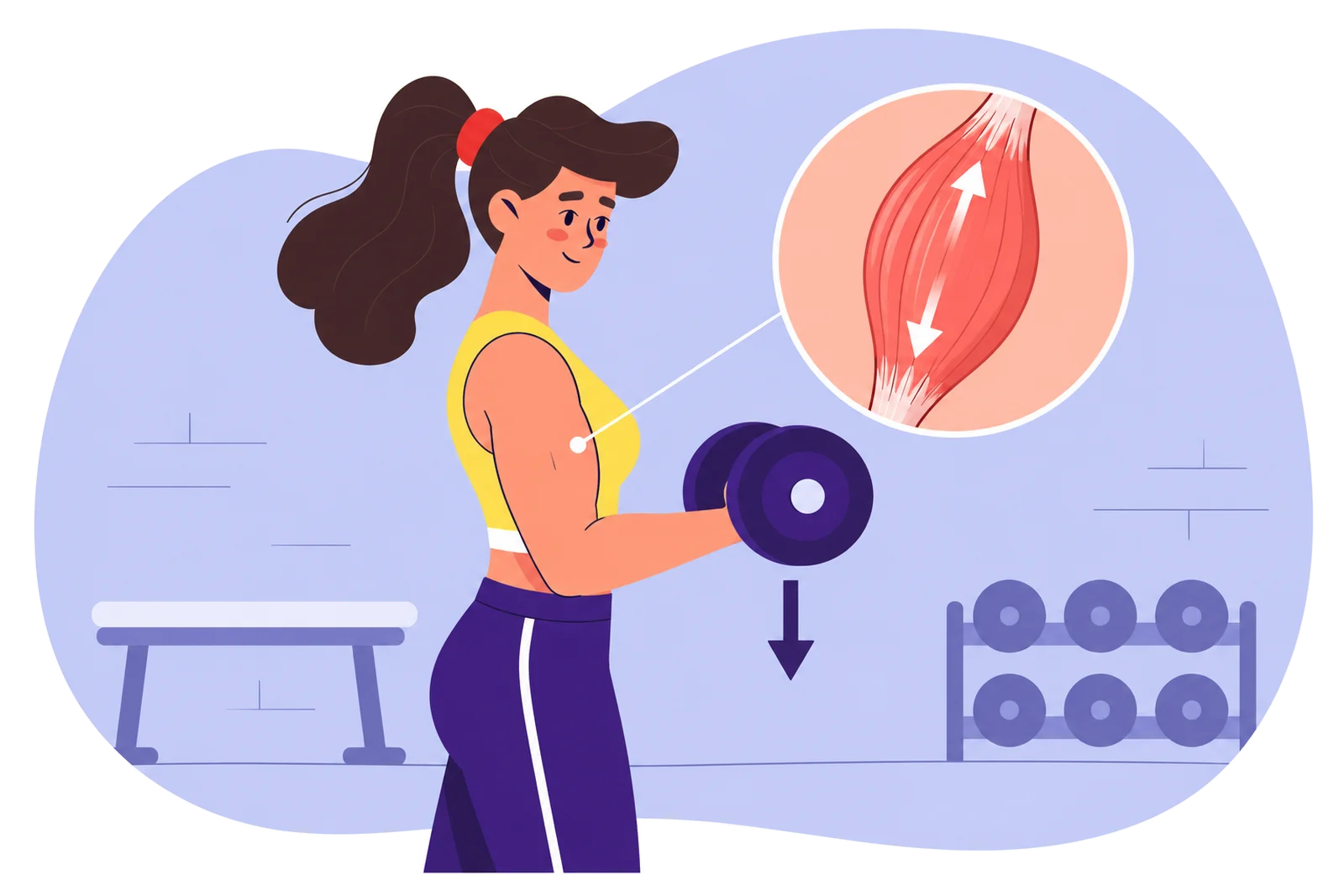
Mechanical tension is the force experienced by muscle fibers and their force-transmitting structures while a muscle contracts under load. In resistance training, it arises when active muscles produce or resist force through a movement or an isometric hold. Mechanical tension is widely considered an important part of the hypertrophy stimulus, but it is not a gym metric that can be read directly from the weight stack.
External training load contributes to tension, yet the internal force experienced by a particular muscle also depends on leverage, joint angle, muscle length, contraction type, technique, acceleration, fatigue, and how much that muscle is recruited. A heavier implement can increase total force demand while shifting work away from the intended muscle. Conversely, a lighter load can still create substantial tension in active fibers when the exercise and effort require them to produce high force.
Cells can detect mechanical deformation and convert it into biochemical signaling, a process called mechanotransduction. However, the chain from a training repetition to long-term hypertrophy involves many interacting signals and remains an active research area. A review of hypertrophy stimuli and sensors treats mechanical, damage-associated, and metabolic factors as hypotheses with different levels of support. It does not justify claiming that one pathway, acute hormone response, or laboratory marker fully explains muscle growth.
Mechanical tension is not the same as time under tension. A deliberately slow set lasts longer, but extending duration can reduce the load, repetition count, or force produced; seconds alone do not quantify the relevant fiber tension. It is also not synonymous with a pump, burning, soreness, or muscle damage. Those sensations and outcomes may coexist with useful loading, but none proves that tension or growth was greater.
In practice, a productive training stimulus usually requires an exercise that loads the target muscle through a suitable range of motion, stable and repeatable technique, enough effort to recruit the necessary fibers, and progression over time. The 2026 ACSM position stand supports hypertrophy across resistance-training approaches and highlights volume and eccentric overload at the group level, while finding no consistent outcome advantage from time under tension alone. This is evidence for managing the whole program, not for chasing one theoretical tension score.