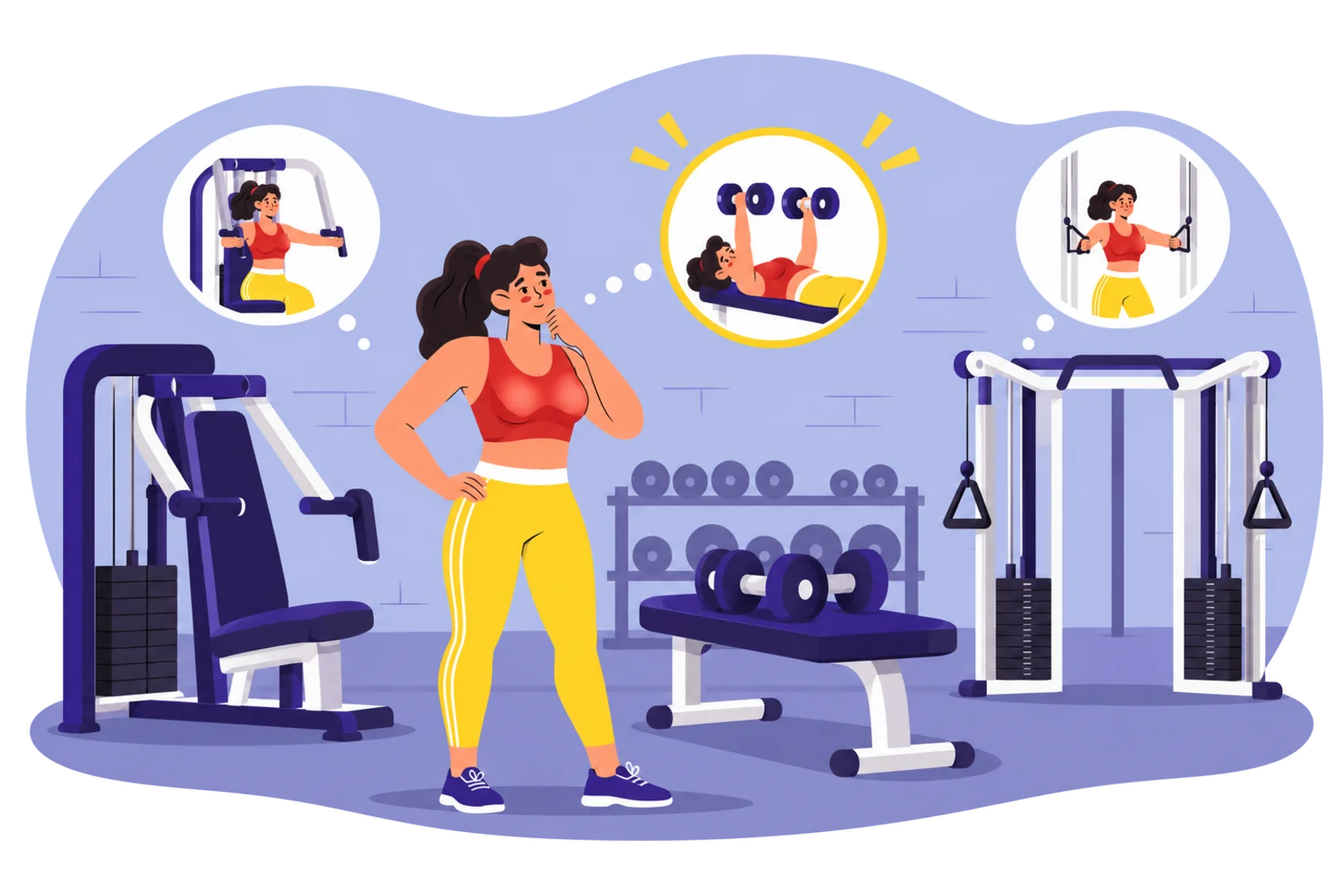
Exercise selection
Exercise selection is the process of choosing which movements belong in a training plan or workout. A good selection covers the intended goals and muscles with exercises that the person can perform consistently, progress, and recover from.
Start with the outcome. Strength in a particular lift calls for practicing that lift or a close variation because of the specificity principle. Muscle growth allows more alternatives, so consider whether the exercise loads the intended target muscle through a useful range of motion, offers enough stability to apply effort, and can be tracked over time. Available equipment, training experience, anatomy, mobility, joint comfort, setup effort, and personal preference can all change the best choice for an individual.
No exercise is universally mandatory, and labels such as free weight, machine, compound, or isolation are not quality scores by themselves. A 2026 American College of Sports Medicine overview of reviews found that equipment type and exercise complexity did not consistently determine training outcomes across the evidence it synthesized. What matters is how a movement serves the goal inside the complete program. Compound exercises can cover several muscle groups efficiently, while isolation exercises can add focused work where needed.
Selection also requires restraint. Keeping productive exercises for long enough makes technique and performance trends easier to interpret. Variation is useful when goals change, equipment is unavailable, a movement is poorly tolerated, or another exercise provides a clearer progression path; random changes every workout make comparison harder. Similar-looking exercises are not always interchangeable because they can differ in stability, joint actions, resistance profile, and limiting muscles.
Exercise selection answers what you train. Exercise order decides when each choice appears within the session, and exercise substitution decides how to replace one while preserving its intended role. Alpha Progression connects these decisions to a searchable, strength-focused library: exercises can be filtered by muscle and equipment, used in manual plans, or selected by the plan generator according to the user's setup. Its exercise-database guide explains the underlying library and guidance in detail.