Training intensity
Redirected from "Intensity"
Also known as: Intensity, Exercise intensity
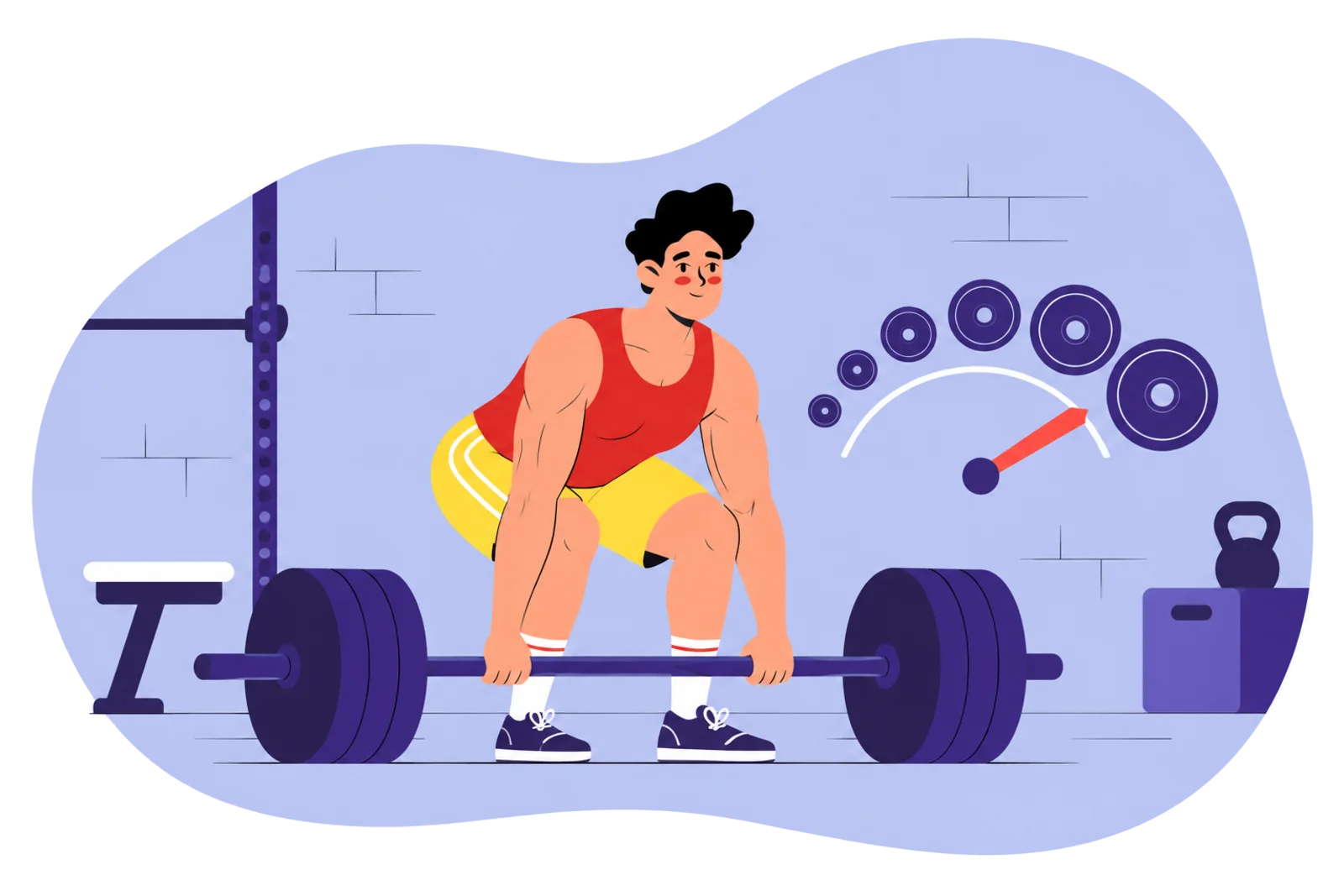
Training intensity describes how demanding an exercise prescription is. In resistance training, it most often means the load relative to a person's current maximum, usually expressed as a percentage of one-repetition maximum. It does not, by itself, say how hard a set feels or how close the set comes to failure.
The same absolute load can represent different intensities for different people. If one lifter has a 100 kg bench-press 1RM, 80 kg is an intensity of 80% 1RM; for someone with a 120 kg 1RM, the same 80 kg is about 67% 1RM. Because maximum strength changes over time and differs by exercise, percentage-based intensity is always specific to the person, lift, and point in time. A percentage derived from an estimated rather than tested 1RM also inherits that estimate's uncertainty.
Intensity is commonly confused with training effort. A light load can require very high effort when it is lifted for enough repetitions to approach muscle failure. Conversely, a heavy load can be a low-effort set when the lifter performs only one or two repetitions despite being capable of several more. RPE and reps in reserve describe this proximity to the current repetition limit more directly.
Outside resistance training, exercise intensity may instead be classified through heart rate, oxygen uptake, pace, power output, or the talk test. The measurement therefore needs to be named: "high intensity" is incomplete unless it is clear whether the speaker means a high percentage of 1RM, high cardiovascular demand, or high set effort. The 2026 ACSM position stand likewise treats load and other prescription variables separately; it reports that heavier loads tend to favor gains in maximal voluntary strength, while many loads can be used effectively for other outcomes.