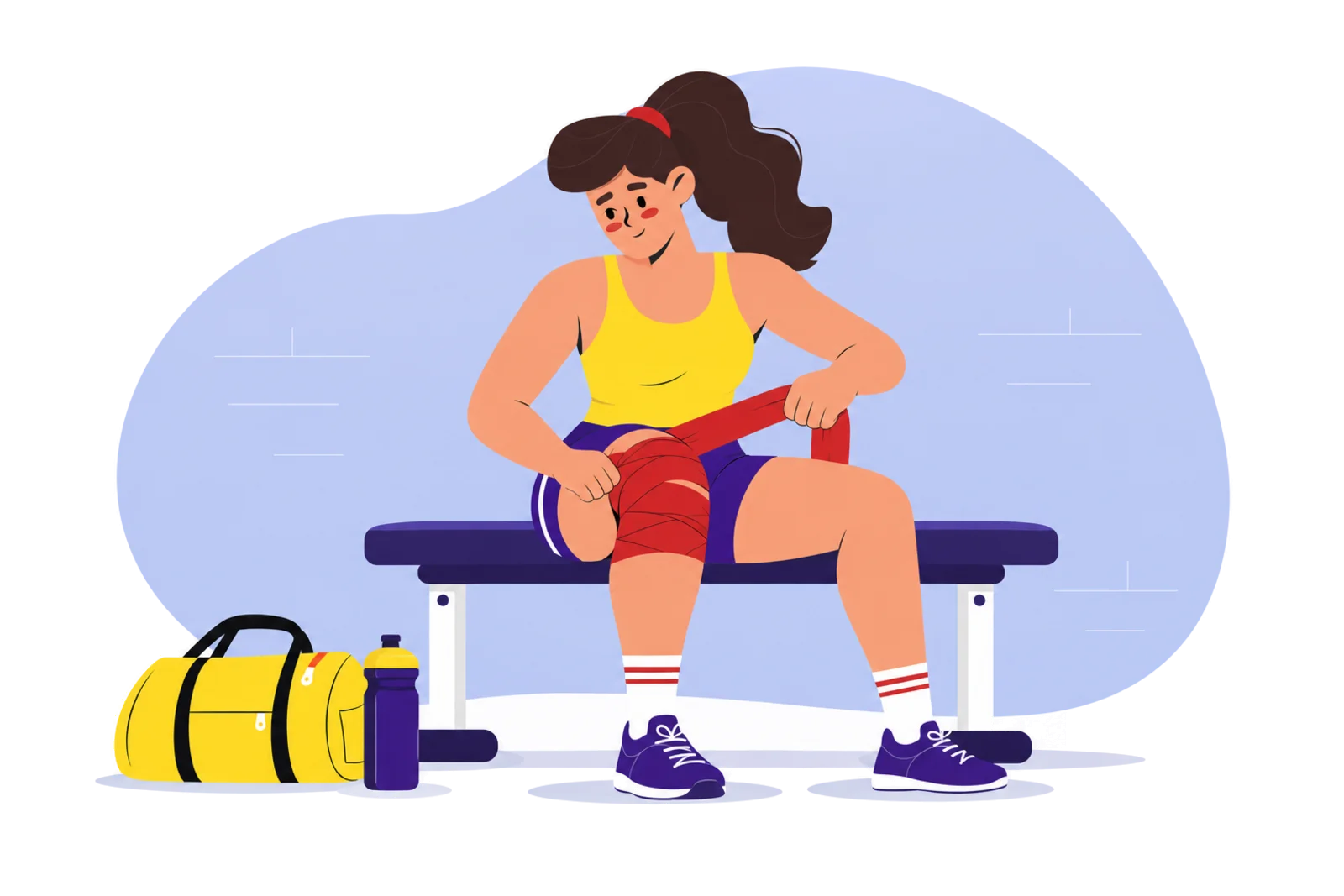
Knee wraps
Knee wraps are long elastic strips wound around the knee under tension, most often before heavy squats. Their compression and stored elastic energy can assist the transition out of the bottom position. They differ from knee sleeves, which are pull-on garments with a fixed construction and usually provide much less adjustable tension and elastic assistance.
The effect of a wrap depends on material, length, stretch, overlap, direction, placement, and how tightly it is applied. Because tight competition-style wrapping can be uncomfortable and takes time, wraps are commonly removed or loosened between attempts and reapplied for a heavy set. The left and right sides should be wrapped consistently if the goal is comparable support.
Wraps can increase acute squat output, but they also change the movement being tested. In a 2012 study of ten trained men, wraps increased mechanical output during squats at 80% of one-repetition maximum and altered descent speed and bar path. This small, short-term experiment demonstrates an equipment effect; it does not show that wraps improve long-term training results or prevent knee injuries.
For powerlifting, wraps are mainly relevant to divisions or federations that permit them. Rules can specify length, construction, wrapping boundaries, and whether the lift belongs in a wrapped rather than raw category. Train with the same wrap and method used for competition, and log wrapped performance separately when comparing maximal strength.
Very tight wraps can cause pain, numbness, tingling, or discoloration. Remove them promptly if these occur, and never use compression to push through unexplained knee symptoms. Wraps do not replace a progressive warm-up, controlled form, or suitable loading. Learning to apply them from an experienced person can improve consistency, but no wrapping pattern guarantees safety.