Cable tower
Redirected from "Cable machine"
Also known as: Cable machine
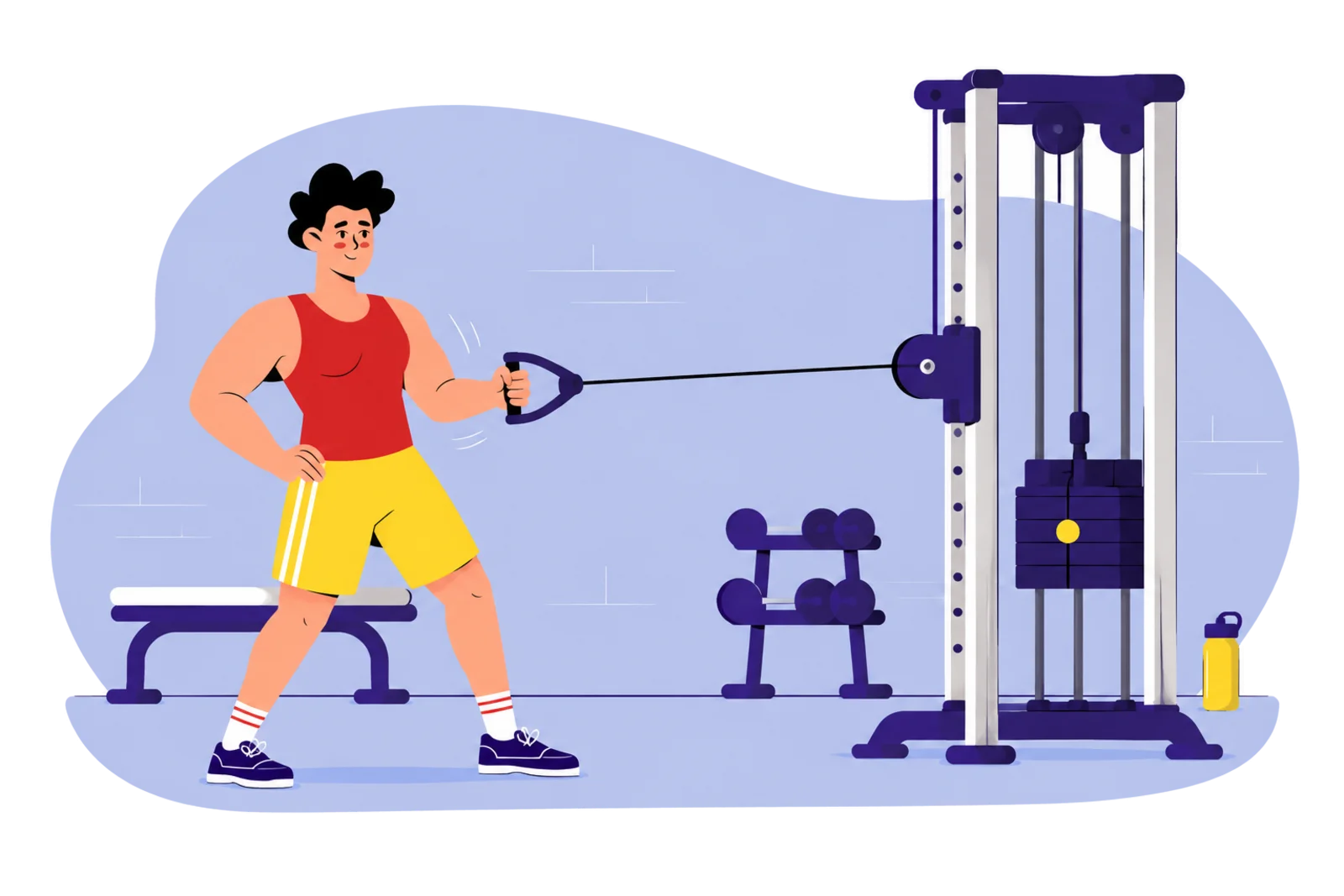
A cable tower is a type of cable machine that transfers a weight stack or plate-loaded resistance to a handle through one or more pulleys. The pulley position sets the line of pull, while the user usually controls the handle path. This distinguishes many cable exercises from fixed-path machines, even though a cable tower is itself a machine.
To set up an exercise, choose the attachment, pulley height, load, and body position. The cable should pull in the intended direction without rubbing against the body or forcing an awkward joint path. A stable stance and a repeatable range of motion make the exercise easier to control and track. Cables can be used for single-joint movements such as lateral raises and triceps extensions as well as rows, presses, and other multi-joint movements.
Cable resistance is not literally constant. The stack may remain loaded throughout much of a repetition, but the torque at a joint still changes as the cable angle, body position, and anatomical moment arms change. Adjusting the pulley or where you stand can therefore change the exercise even when the selected stack weight stays the same. That makes setup part of both exercise selection and form.
The number printed on a stack does not always equal the force at the handle. Pulley ratios can provide a mechanical advantage, while friction, moving parts, and calibration differ between models. A setting of "40" on one tower may not match "40" on another. For useful progress comparisons, record the exact station, attachment, pulley height, and selected setting rather than treating all cable labels as interchangeable available weights.
Before a hard set, check that the pin is fully inserted, the attachment is closed, and the cable and carabiner show no obvious damage. Keep fingers away from the stack and pulleys. A cable machine can reduce some balance demands, but it does not make every setup or repetition automatically safe.